Mark
Mark 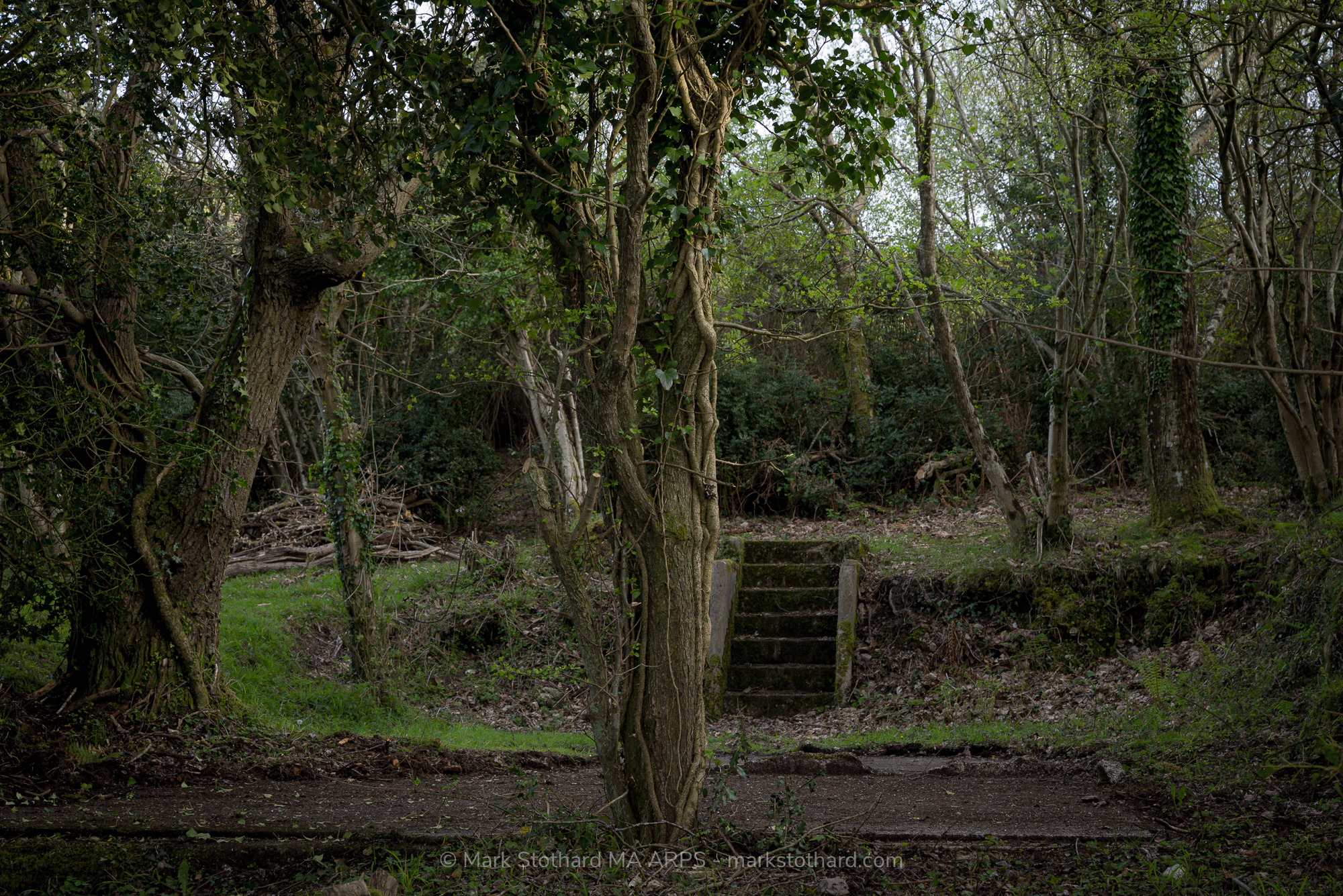
Residual Concrete, persistent Ground analyses the abandoned military platforms on North Hill, Minehead, as intentional survivals rather than mere neglect. While the concrete endures, the steel has disappeared. The inquiry extends beyond their persistence to consider why these structures were deliberately left in situ.
Following the Second World War, Britain experienced austerity. Scrap metal held immediate commercial value, as steel could be cut, melted, and reintegrated into the post-war industry. Conversely, concrete lacked such value. Reinforced slabs demanded labour-intensive removal and yielded minimal financial return. During the 1950s, demolition without redevelopment was seldom economically justified. The armoured fighting vehicle range closed in 1944, and the land reverted to civilian control. Materials with resale value were removed; those without remained.
However, economic factors alone do not fully account for this persistence.
The platforms, ramps, firing bases, and marshalling areas, now embedded within woodland and moor, function as material residues forming a discontinuous archive across the landscape. Roland Barthes’ distinction between studium and punctum elucidates this condition. Studium corresponds to historical literacy, in which the observer recognises standardised military geometry. Features such as angled blocks, concrete aprons, and loading bays signify training routines, refuelling points, and fire trajectories. These elements situate the image within shared cultural knowledge of twentieth-century mechanised warfare.
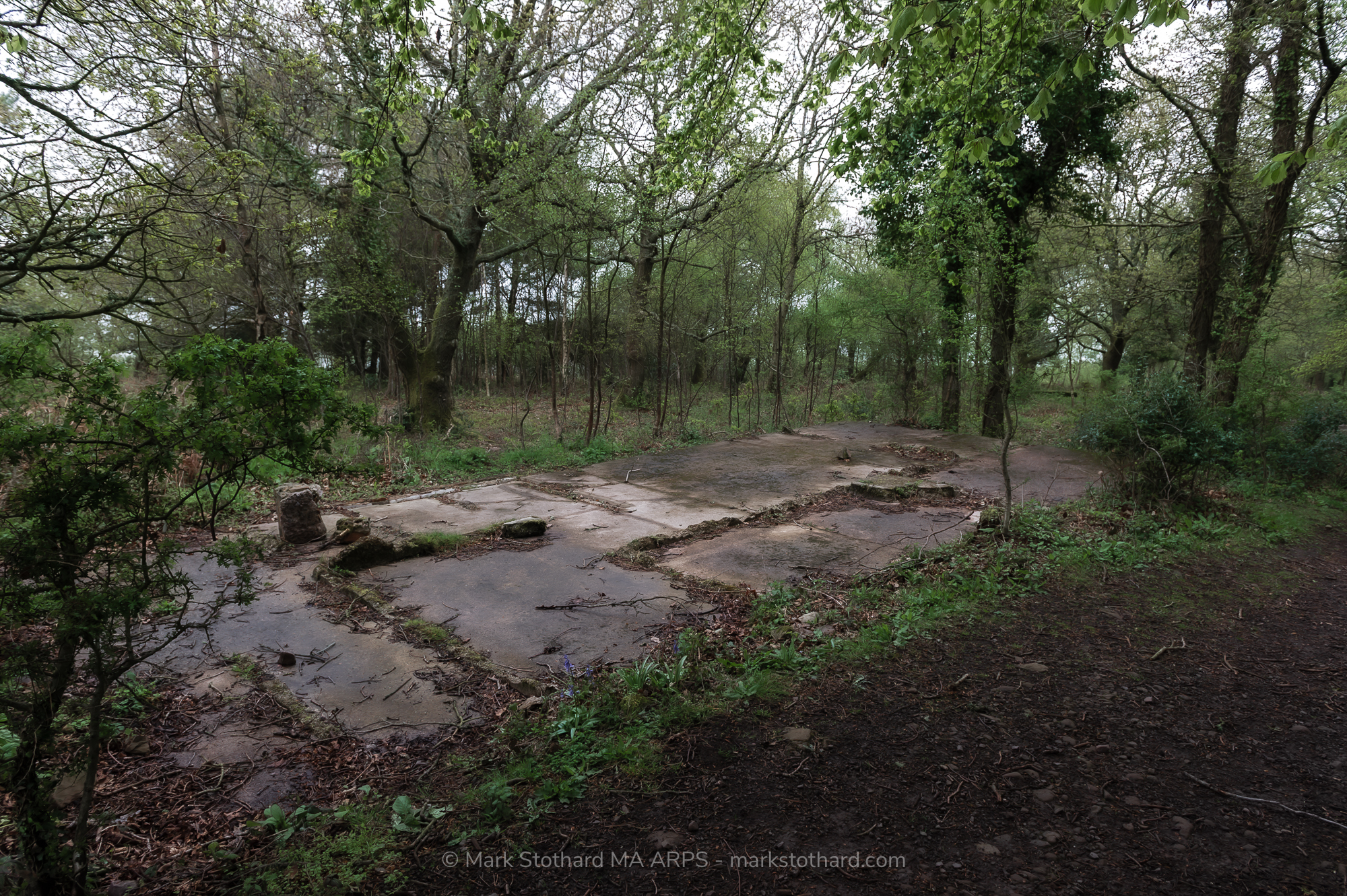
The punctum manifests in other details: moss accumulates in drainage channels, grass emerges through expansion joints, and rainwater collects in shallow depressions originally cut for alignment. These features evoke a sense of duration by revealing the slab’s loss of original function. The concrete now retains water, soil, and leaf litter, thereby marking the passage of time.
Affect theory further refines this interpretation. Brian Massumi contends that affect precedes emotion, circulating as intensity prior to articulation. The concrete embodies this intensity, inducing a shift in bodily perception. A walker traversing the woodland experiences an interruption beneath their feet: the ground hardens, sound alters, and temperature changes. These pre-cognitive shifts register as atmosphere before narrative. Although the structure is inert, its effect remains active.
Psychogeography offers a methodological approach. The dérive emphasises drift and encounter rather than mapped intention. At North Hill, walking serves as a means to trace military logistics without reenactment. Roads that formerly directed tanks now guide ramblers, and platforms once restricted now invite pause. The concrete continues to shape movement long after its tactical function ceased, scripting circulation and modulating rhythm.
Dr Simon Standing’s research on dark heritage and conflict landscapes emphasises that sites of former violence persist as affective fields rather than didactic memorials. The North Hill platforms neither instruct nor monumentalise; instead, they remain present. Their silence resists closure, rendering their survival atmospheric rather than commemorative.
Posthumanist theory further develops this argument. Rosi Braidotti conceptualises the posthuman subject as embedded within material networks rather than positioned above them. Francesca Ferrando similarly rejects human exceptionalism in favour of relational ontology. The concrete participates in this entanglement; it is not merely a backdrop but an agent within a mesh of soil compaction, root growth, moisture retention, and human footfall. The slab alters drainage patterns, influences plant succession, and conditions insect habitats. It remains a material fact.
From this perspective, the inquiry shifts: the concrete was not merely abandoned; rather, it persists within a network that transcends economic logic.
Tourism introduces additional complexity. Contemporary heritage tourism often prioritises coherent narratives, with battlefields featuring signage, visitor centres, and curated routes. North Hill lacks such infrastructure; its concrete fragments function as unmarked prompts. The absence of formal interpretation permits multiple readings: one visitor perceives redundant infrastructure, another envisions preparation for invasion, and a third experiences quiet estrangement. Retaining the concrete in situ may serve as a tacit form of remembrance, avoiding spectacle and enabling a slow encounter.
Slow tourism reinforces this dynamic by resisting rapid consumption and encouraging proximity and duration. Walkers observe triangular blocks aligned along the platform edge, which formerly guided vehicle positioning. Presently, these blocks form a visual pattern against the gorse and sky, with the sea beyond. While firing once extended toward that horizon, the current view appears pastoral. The tension between past function and present tranquillity generates. Economics, affect, and ontology intersect in this context. The state removed recyclable materials, leaving those without value. Over time, neglect evolved into a condition; condition transformed into atmosphere; and atmosphere became heritage phere became heritage.
Barthes’ concept of studium situates the slabs within the context of wartime training, while punctum resides in their erosion. Affect captures the bodily encounter; psychogeography traces its spatial influence; posthumanism situates the slabs within ecological processes; and tourism mediates their contemporary reception.
The concrete persists due to the absence of removal incentives, the return of land without mandates for erasure, its integration into ecological succession, and its ongoing influence on human movement and perception.
Residual Concrete, Persistent Ground thus positions photography as an analytical witness to material endurance. The camera documents infrastructure in suspension rather than romanticised ruin. The images reject nostalgia, portraying platforms as neither sacred nor obsolete, but rather holding them in tension among utility, abandonment, and involvement.
The concrete was not merely abandoned; it represents a layer of the twentieth century embedded within the soil. This layer remains visible, active, and unresolved.
Publish the full editorial and associated images in your magazine, journal, or platform. Request tailored versions in different tones or formats. Book the author as a guest speaker for your event or programme. Contact the Author.
Be kept up-to-date with my research
* indicates required
Bibliography
Barthes, R., 2000. Camera Lucida. London: Vintage.
Braidotti, R., 2013. The Posthuman. Cambridge: Polity Press.
Ferrando, F., 2019. Philosophical Posthumanism. London: Bloomsbury Academic.
Massumi, B., 2002. Parables for the Virtual. Durham: Duke University Press.
Standing, S., 2020. Landscapes of conflict and dark heritage. Journal of Heritage Tourism, 15(5), pp. 1 to 15.
Debord, G., 1958. Theory of the Dérive. Internationale Situationniste, 2, pp. 1 to 8.