Mark
Mark 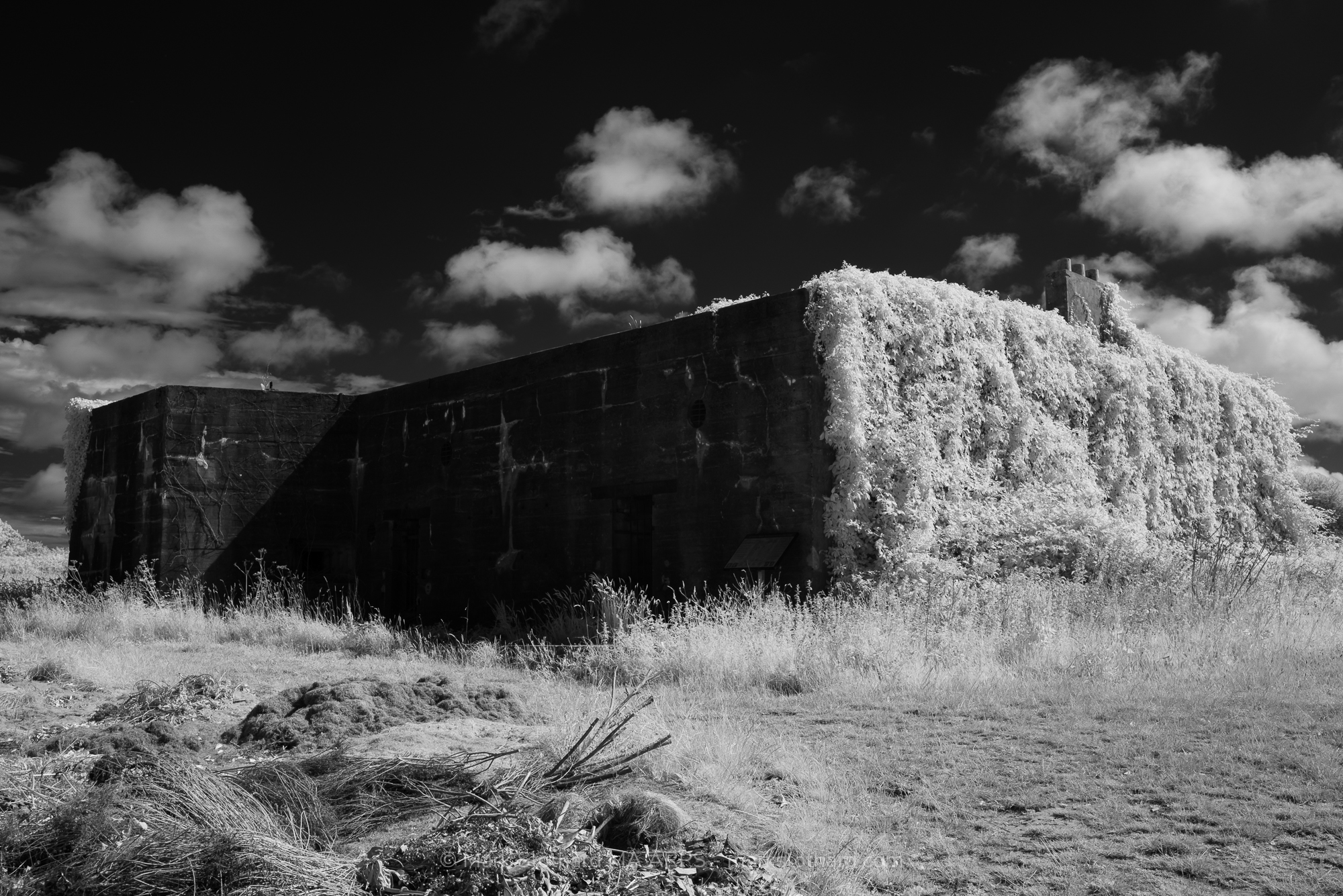
Viewed from the perspective of a posthumanist photographer, the infrared image of the Kernwerk Infantry Regiment Headquarters in Jersey transcends documentation to become a meditation on the complex entanglement of human history, nature, and the lingering emotional effects of conflict. The bunker, a Regelbau 609SK, which once symbolised human dominance and military precision, now stands as a relic of anthropocentric ambition, its rigid geometry gradually softened by the encroaching wilderness. The infrared spectrum reveals a surreal interplay between artificial structures and organic forms, as the bunker’s cold, unyielding concrete contrasts with the luminous, spectral glow of the vegetation reclaiming it. This visual tension prompts reflection on the posthuman condition, illustrating how landscapes bear the scars of human intervention while maintaining their own agency and reshaping narratives of power and control.
The image evokes the spirit of the flâneur, the fugueur, and the dérive, drawing the viewer into a contemplative exploration of space, memory, and emotion. The turbulent sky, a dramatic interplay of light and shadow, reflects the internal turmoil of societies shaped by war and occupation. In this context, the bunker functions as a palimpsest of human emotion, encompassing fear, resilience, and the subdued sorrow of abandonment. Simultaneously, nature’s gradual reclamation of the site offers a form of ecopoetic redemption. The scene resonates with the concept of Naturalia, as the unfiltered beauty of the natural world asserts itself over the remnants of human conflict.
From a posthumanist perspective, this image represents more than a study of contrasts; it serves as a visual poem and a dérive through time and space, in which the boundaries between human and non-human, past and present, destruction and renewal merge into a singular, evocative tableau. The composition challenges viewers to perceive the landscape not as a passive backdrop for human activity, but as an active participant in the ongoing narrative of coexistence and transformation.
Be kept up-to-date with my research
* indicates required
Bibliography
LandmarkScout. (n.d.) Kernwerk – German Headquarters at St. Peter’s, Jersey. Available at: https://www.landmarkscout.com/kernwerk-german-headquarters-at-st-peters-jersey-united-kingdom/ (Accessed: 1 July 2026).